Sunday, 4 August 2013

WHAT REALLY HAPPEND IN NSEL

I’ve been getting a few questions about NSEL and its operations. Here’s my quick take.

Aren’t NSEL’s contracts fair anyhow? So what if people wanted to finance using them?

Firstly, if you set up a financing scheme then the system has to be regulated in terms of assessment of NPAs, provisioning and margining. You would actually need very strong margin management, customer wise position limits, capital adequacy checks of the exchange, etc. So yes, it’s ok to run it as a finance scheme, but you should just finance, not do this drama.
What it has done is push agri products into warehouses while people play with the money used to finance them; effectively keeping those products out of the hands of people who will consume them.
Thirdly, they got approval for one day forwards. What they created T+25 and used some technical language to call that a one-day forward, that was in my opinion a violation of rules.

But what if there was a genuine arbitrage?

People will tell you that farmers wanted to sell today at price X. Mills (who use the stock) wanted to buy 25 days or so later, but at a higher price. Who is stupid enough to do this consistently? Are all our mills running on serious JIT inventory management techniques that they are willing to pay 15% (pa) higher to get stuff late? Isn’t village land ludicrously cheap enough to be able to store the darn thing for nearly free even if it is so?
But the genuineness of the arbitrage fails when you look at any contract of the near and far terms. You will find that nearly at all times, the open interest in any near-far contract is EXACTLY the same.
Take a look at the Castor-Seed contract for Kadi delivery – there is a 3 day contract, and a 36day contract. If there was genuine end-user demand for these contracts, then you might find at least a few open contracts at the 3 day level that will be higher or lower than the contracts at the 36 day level. Answer: No. Looking at EVERY SINGLE DAY in 2013, not a single day did you find a difference in the open interest between the two contracts. There are volume differences but that could be due to intraday trading (no longer allowed). Here’s a sample from Jan 2013:
image
This doesn’t bode well.

Were the contracts designed for such financing? Did the exchange know?

I give you exhibit #1: The Jeera (Cumin seed) contract specification, which says:
Storage Charges are waived off for those members and their constituents, who sale Jeera on JEERUNJH25 out of the delivery receivable against the purchase position of JEERAUNJH2 contracts.
So if you specifically make it cheaper to do the round trip trade rather than take delivery…well, it’s difficult to say the exchange was not aware.

But isn’t it all backed by collateral? What’s the problem then?

Here’s the operation: a “lender” buys a 2 day contract and simultaneously sells a 25 day contract. The ‘borrower’ gets money after two days, and will have to return it in 25 days and take his goods back.
So what happens if there’s a default in the 25 day contract? Answer: they have 2% margin from the buyer of the second leg (the “borrower”). And then they have the goods.
But in a system wide crisis, they can’t easily sell the goods, because the market prices will fall especially when players know someone’s going to dump a large amount on the market.
This is if you believe the goods are actually at the warehouses, and haven’t been spoilt after years of this moving back-and-forth thing.

What’s next? Will I get my money back? Does that mean FT is a good investment?

I believe most investors will be paid back, at least partially. The sad thing is that FT hasn’t immediately dipped into their settlement guarantee fund, but it’s a little doubtful how that fund is composed – if it includes broker deposits then that part can only be used to guarantee against defaults from that broker’s clients.
But there definitely is some stock, and over the next few months they might be able to repay most of the money. They will need to liquidate stock slowly to ensure the market doesn’t collapse. But in some situations where they are a large part of the (remaining) market, prices will fall anyhow.
As they recover money they will pay back and it’s even possible that investors get paid off in full, eventually.
But FT’s reputation looks increasingly weak. Unless they pull off a huge turnaround like paying back everyone immediately and taking the hit themselves (by borrowing or getting a large agri-based investor). Short of that, their future revenue growth – claimed to come largely from exchanges, in India and abroad – is going to be stunted because no one will want to deal with an entity that delays settlement.
There is a big political angle to this as well. If agri-good prices tank, farmers will hurt when they bring their produce to the market. It’s even possible a government agency or FCI helps. Remember, this is what the US Fed did with banks who had “dodgy” assets – gave them time to unwind, and even bought some of those assets to help banks tide over. But the question I leave unanswered is: Is NSEL too big to fail?

Mutual Funds that Owned Shares of Financial Technologies

Mutual funds owning FT stock are largely from the Reliance and Birla stable, it seems. Going purely from the shareholding on Jun 30 (the last we have) the shares they own are as follows, aggregated by AMC.
FT Shares held by Mutual Funds
Note that all of these are shares held on behalf of mutual fund holders.
In Bulk trades yesterday a few of the top shareholders exited their stake. Remember, anyone trading more than 0.5% of the days volume will get reported as bulk trades. Looking at the NSE and BSE together it seems that Birla and Reliance have exited part of their portfolio. (If the others were to exit, they would be too small to be reported in bulk trades, so it’s likely that they’ve exited as well)
Bulk Sellers of FT
Amal Parikh is probably related to the guys at Pivotal Securities, a firm that owns a large stake in FT.
Note that Birla sold at Rs. 271, which Reliance sold (in both BSE and NSE) at about 212. (Current prices are around Rs. 150)
Every single mutual fund scheme has a different account, and many funds have very tiny holdings, so their sales will also be invisible right now.
I’m saying that because you shouldn’t rush to sell the following mutual funds, which have reported holdings of FT as of Jun 30. Just for reference:
AMC Fund Shares % of portfolio
Reliance Reliance Growth Fund - RP  19,80,807 3.41%
Birla SL Birla SL Frontline Equity  4,70,196 1.16%
Reliance Reliance Equity Fund - RP 3,13,236 2.49%
Birla SL Birla Sun Life Midcap Fund  2,46,676 1.80%
Birla SL Birla Sun Life Equity Fund  1,04,811 1.25%
Reliance Reliance RSF - Balanced  1,01,220 1.46%
Birla SL Birla Sun Life 95 Fund  86,487 1.16%
Birla SL Birla SL Special Situations 43,142 2.44%
Birla SL Birla Sun Life Top 100  41,343 1.06%
Birla SL Birla SL Intl. Equity - B  39,210 1.97%
Birla SL Birla SL Advantage Fund  34,206 0.96%
Birla SL Birla SL India GenNext  15,510 0.84%
Religare Religare Invesco Tax Plan  12,442 0.72%
Birla SL Birla SL Small and Midcap Fund  10,225 0.87%
Reliance Reliance Growth Fund - IP  8,908 3.41%
Religare Religare Invesco Contra  7,363 1.21%
Reliance Reliance Growth Fund -Direct  7,303 3.41%
ING ING Multi-Mgr Eqty -A  5,560 2.37%
Religare Religare Invesco Mid Cap  5,040 0.78%
Birla SL Birla SL Long Term Advan.  4,989 0.29%
Birla SL Birla SL Frontline Eqty-Direct  4,044 1.16%
Birla SL Birla SL New Millennium  3,202 0.56%
Birla SL Birla Sun Life MIP  2,950 0.17%
Religare Religare Invesco Mid N SmallCap  2,597 0.75%
Birla SL Birla SL Midcap Fund -Direct  1,210 1.80%
Reliance Reliance RSF - Balanced -Direct  936 1.46%
Birla SL Birla SL India GenNext-Direct  675 0.84%
Birla SL Birla SL Top 100 - Direct  665 1.06%
Birla SL Birla SL 95 Fund -Direct  658 1.16%
Goldman GS CNX 500 Fund  491 0.06%
Birla SL Birla SL Equity Fund -Direct  381 1.25%
Birla SL Birla SL Advantage Fund -DIrect  310 0.96%
Birla SL Birla SL Small & Midcap -Direct  215 0.87%
Reliance Reliance Equity Fund -Direct  156 2.49%
Religare Religare Invesco Mid N Small-DP  50 0.75%
Religare Religare Invesco Tax Plan - DP  50 0.72%
Religare Religare Invesco Contra - Dir  30 1.21%
Religare Religare Invesco Mid Cap-Direct  27 0.78%
Birla SL Birla SL Special Situat.-Direct  22 2.44%
Birla SL Birla SL Intl. Equity B -Direct  13 1.97%
Birla SL Birla SL MIP - Direct  10 0.17%
Goldman GS CNX 500 Fund - Direct  7 0.06%
Birla SL Birla SL New Millennium-Direct  6 0.56%
Birla SL Birla SL Long Term Adv. -Direct  2 0.29%
ING ING Multi-Mgr Eqty-A -Direct  2 2.37%
(Source: Moneycontrol)

Sell in May and Go Away Proved Right for the first time since 2001

July ends with a –1.7% return on the Nifty and it is the first time since 2001 that we have had a negative June followed by a negative July. This is not huge – the aggregate fall is less than 5% – but it does take the Nifty into a –2.8% number for the year.
 The Sensex fell only 0.3%, the difference being the relative weights of stocks in the indexes, plus the fact that the Sensex has 30 stocks while the Nifty has 50.
And here’s the relative moves YTD till July:
Where does the index go in August? Since 2000, we have seen only three negative Augusts (2001, 2007 and 2011), and the remaining nine are positive. Given the liquidity squeeze, expect more negative moves – or, is there something the government is planning that will help the markets?  

Friday, 2 August 2013

ARE WE IN A BEAR MARKET WITH A BULLISH NIFTY/SENSEX?

Indian Equity Markets were at an inflection point and we could see some big moves.

Sensex/Nifty was expected to bounce back and Nifty to target 6200-6300 levels. After making a low at 5580 the Nifty did move up to 6080-6090 levels

Even Now the Nifty is trading at 5650-5670 and above the long term trend line. But the whole assumption that Index could lead the broader markets has fallen flat on the face.

This is how the Sensex chart looks.
Sensex thumb We are in a Bear Market with a Bullish Sensex/Nifty
Nothing seems to be wrong technically till we dont break 18400 levels. A similar level for Nifty would be 5550-5600.

Even the bounce of 8-10% on the index could not make an impact on the broader markets. What we have seen is the broader markets or rather midcaps/smallcaps have just collapsed.

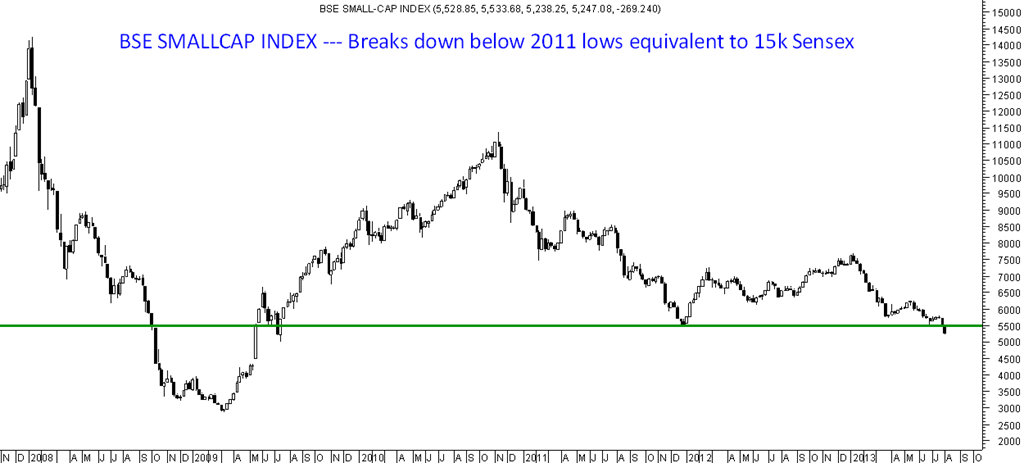
Look at the small cap index

SmallcapMayhem thumb We are in a Bear Market with a Bullish Sensex/Nifty

The index is now below 15k Sensex levels and 4500 Nifty levels. So the mayhem is terrible. Quite a lot of manipulated stocks have just collapsed.
At the same time quality small caps have fallen into the Put Call Option System. This has led to a fall in quite a lot of quality companies with terribly low volumes and have seen a drop of 30-40%. There are many bargains available but the liquidity hurts any investment.
Falls of such size generally leads to big opportunities but one needs to be patient.
Markets have seen 1992 Harshad Mehta , 2000 Ketan Parekh and global falls in 2008-2009 and 2011.
So over a longer period of time quality stocks do catch up and fresh opportunities also come.

In the short term what we envisage is leveraged , manipulated and mid caps can see some panic falls. As we know panic has no logic and there is no point in being brave.

Also the best research is done in Bear Markets and this is when people don't really want to look at companies. So if you have good low debt companies and even if they are down 30% you just need to re- asses the investment logic. If there is no fundamental change just be patient for another year or two and you will be rewarded.

We at  are also seeing sharp falls of 30% in many of the recommended stocks but on terribly low volumes in smallcap stocks recommended. But there is no major fundamental change to warrant discomfort. Mind you the stocks do not comprise the Dlfs or Suzlons. Also in smallcaps the stocks just need 2 upper circuits to change the whole return factor in good times.

At the same time the short term trades have been profitable with nice moves in Nifty, Tech Mahindra, Bharti Airtel and some shorts in Fin tech , ITC , Adani and so on.

The strategy now is to be conservative with investment ideas , be patient, conserve cash but do a lot of research. Trading side it is a mix of long/short and strategies with strict stop losses. Also be ready for any sort of panic if Nifty breaks 5550 but with index management it may not be seriously damaging as certain sectors like IT are breaking out ( Infosys ), Bharti  and the weight-age of FMCG and Reliance increasing which may remain resilient. So a drop in Nifty will be well managed and with the current conditions a Nifty level is irrelevant for an investor/trader. There will be lots of rumors of a lower circuit in Nifty and so on over next couple of months. When people go on to that sort of despondency we may review to look for buying opportunities till that time be conservative and relax.

Technically we may continue to look for short term reversal signals if they do come by. If we do see a total trend change we can change the cautious stance. Also the shorts we are taking in trading are with extremely small stop losses and few as bear rallies can be big.

Some stocks which come into radar in the small cap screen is NBCC at 80-100 , Elecon Engineering at 12-15 levels where we might review whether to enter them.


IS FMCG A safe sector to bet on ?– I fear Not at All:

Over the last few months i have heard a lot of fundamental analyst saying people were stupid buying the Cyclical stocks.

They just keep giving examples of how one should buy good cash flow companies in the FMCG sector. Also there are many examples of how ITC, Hindustan Unilever, Godrej Consumer, Colgate and Dabur have withered the current storm and have given positive returns.

Actually Nifty has been able to hold on to 5500 levels because of the huge outperformance by ITC and HUL.

Over the last 3-4 years from the lows of 2008-2009 to 2013 quite a lot of stocks have moved up 3-4 times and 300-400 %.

Flash back to 2006-2008. Analysts would call the FMCGs a sluggish sector and what not because they did not perform at all when the Unitechs and Suzlons were zooming.

Let us look at the last 10-15 year performance of the above FMCG stocks.

Hindustan Unilever – No returns for 10 years. 
HUL thumb FMCG – A safe sector to bet on – Not at All 
-> Hindustan Unilever the stock has doubled in the last couple of years.
-> Also above chart is not adjusted for the dividends.
-> After 1999-2000 tops of 320 the stock did not cross the levels of 320 for the next 10-12 years.
-> In this period the stock even dropped down to a low of 100 in 2003-2004.
-> If you would have bought in 2003-2004 the returns would have been phenomenal but if in 2000 you would be in a terrible investment.
->The stock was a major underperformer in 2006-2008 where we saw the biggest gains in equities.
-> The stock has done superbly in last couple of years does not guarantee the same for next 5 years.

ITC – Superb Returns though some sideways period for 2-5 years. 

 ITC thumb FMCG – A safe sector to bet on – Not at All

-> One of the smoothest chart in last 10 years.
-> But if you were to look at the phase of 1999-2004 the stock could not cross 1999 highs.
-> Similar periods was also seen 1992-1997.
-> Also in 2006-2008 it could not cross 2006 highs.
-> The stock also fell 40-45% from peak in the drop of 2008.
-> The major returns in the stock have come from 2009-2013 where in it has given 3-4 times return.
-> Does this guarantee a similar move in next 5 years ?

Colgate – A big FMCG stock with the longest sideways cycle

Colgate thumb FMCG – A safe sector to bet on – Not at All
-> The stock had the superb run in the 1980-1990 ( I believe people got it cheap in the IPO because of the regulations and compulsions in the 1980s )
-> After the superb run in 1994 the stock could not reach similar levels till 2009. This is like 15 years. This is not a dividend adjusted chart so returns came only in form of dividends.
-> The stock saw a good correction also in the next many years from 1994.
-> But if you would have bought in 2004 i would be 6 times in next 5 years.
-> The stock remained sideways in the bull market of 2006-2008.
-> Majority of the returns have come in 2009-2013.


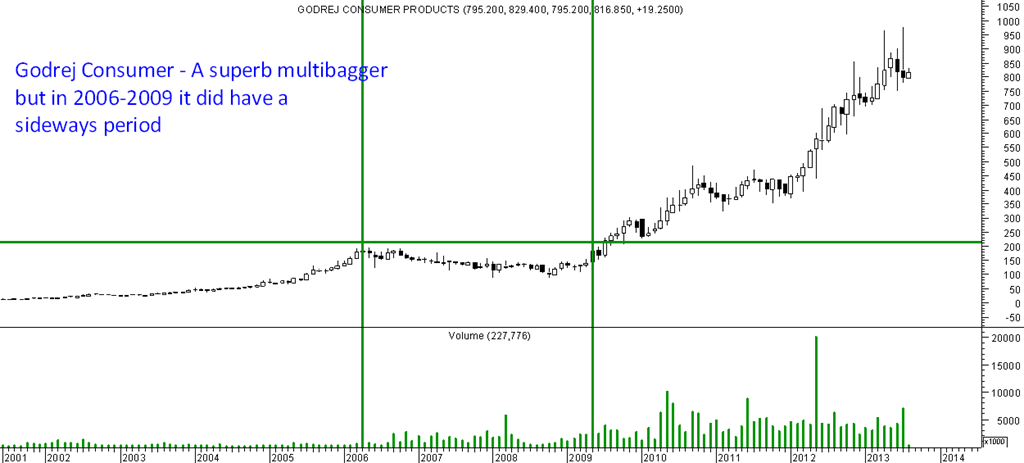
Godrej Consumers – A superb Multibagger in last decade
godrejconsumer thumb FMCG – A safe sector to bet on – Not at All

-> This has been the biggest mover in the FMCG segment with lesser dips and sideways period.
-> In 2006-2009 the stock did remain sideways but did not fall as much in the crack of 2008.
-> The stock has moved up 5-6 times in last 5 years.
-> If you were to look at from 2001-2002 the stock has been just amazing !!!

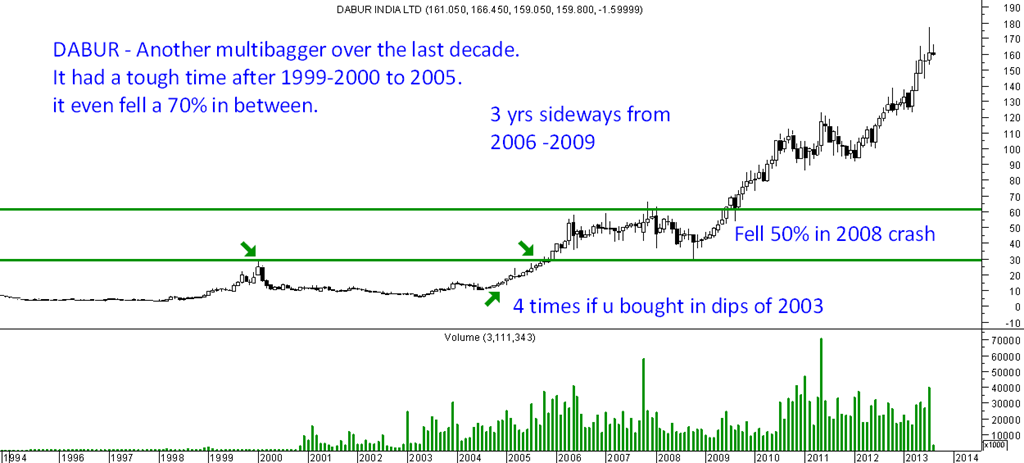
Dabur – A steady performer but the top in 1999-2000 was painful.

Dabur thumb FMCG – A safe sector to bet on – Not at All

-> The stock has moved superbly from the lows of 2003 and 2009 giving superlative returns.
-> As like others it saw a major sideways period between 2006-2009.
-> The stock also did drop 50% in the fall of 2008.


From the above analysis what we come to know is

-> FMCG stocks can also fall 50%.

-> FMCG stocks have 3-4 years of sideways period and can drop 50% in the interim.

-> Many older FMCG stocks also had a 10-14 year sluggish period.

-> FMCG stocks underperform terribly in bull markets like they did 2006-2008

-> After a major euphoric move in a decade FMCG stocks can get into a terribly frustrating stock movement for many years. ( 1992-1994 , 1999-2000)

-> The  drawdowns or pits or not like other cyclicals which fall 80-90% from peaks. ( Look at Tata Motors, Infosys, Tata Steel etc )

-> FMCG stocks are not immune to bear markets.

-> FMCG stocks tend to underperform terribly in bull markets.


Conclusions – The best time to buy FMCG is when they are available at good dividend yields and after a long sluggish period for investors.
So if you are buying FMCG today then better be aware that after a year or two or maybe we may right now be at 1994/2000/2006 type topping out.
Do not let the superb run of last 3-4 years be the deciding factor to choose FMCG stocks. HUL buying at 600 is more a loan arbitrage ( Yeye they raised a billion dollars in US check this link  ).

If an investor do a little more research before just taking A so called SIP in HUL or FMCG stocks. This may not be the best time for FMCG.
The best buy in FMCG are new brands. According to me that could be Bajaj Corp ( Example Marico and Godrej did superb in last decade)
For traders the best time to buy FMCG is in 3/5/10 year highs.

CALL OF THE MONTH: COAL INDIA BOKED PROFIT 41000 RS JUST 2 DAYS

THIS WAS MY POST  2 DAYS BACK
http://trendzofmarket.blogspot.in/2013/07/coal-india-heading-towards-250.html


COAL INDIA SOLD AT 285 IN FUT BOOKED PROFIT  NOW 256 LOT SIZE 1000 TOLD TO BUY PE AT 3.75 PS NOW 16.50 WENT UP 5 TIMES IN JUST 2  DAYS
PROFIT 29000 RS IN FUT & 12750 IN OPTIONS TOTAL 41750


COAL INDIA   I POSTED  HERE IN MY BLOG  2  DAYS BACK ON 30 TH JULY TO SELL COAL INDIA NEAR TO 285 IT CAME TO 256 GAVE US THE OPPORTUNITY TO GO SHORT ON THE COUNTER TO TO BUY 270 PE ALSO IT WAS PURELY A TECHNICAL BREAK DOWN  AGAIN CHARTS DON'T LIE AFTER THE TECHNICAL  BREAK DOWN HAPPENED YESTERDAY NEWS CAME ABOUT THE OFS GOVT PLANNING TO DO